Inside Miami International Airport’s Agentic AI Virtual Assistant Experience
21 September 2026 • 5 min read
Main page » Success Stories » Inside Miami International Airport’s Agentic AI Virtual Assistant Experience
What does the airport of the future look like? Miami International Airport is on a mission to show you.
As part of a Future-Ready Strategy, backed by Miami-Dade County Mayor, Daniella Levine Cava, MIA has done what no other airport has done before. They set out to build a passenger experience powered by AI and emerging technology. The fastest growing airport in the US and a key gateway to the Americas – welcoming over 55 million passengers in 2025 – MIA needed a solution that matches the diversity of its audience: multiple generations, multiple languages, multiple preferences for how they want to get help.
“We’re not just keeping pace with innovation. We’re leading it, harnessing artificial intelligence to transform how we serve our visitors and our community every day. At Miami International Airport, we are creating a smarter, more connected, and truly future-ready Miami-Dade County.”
– Daniella Levine Cava, Mayor of Miami-Dade County
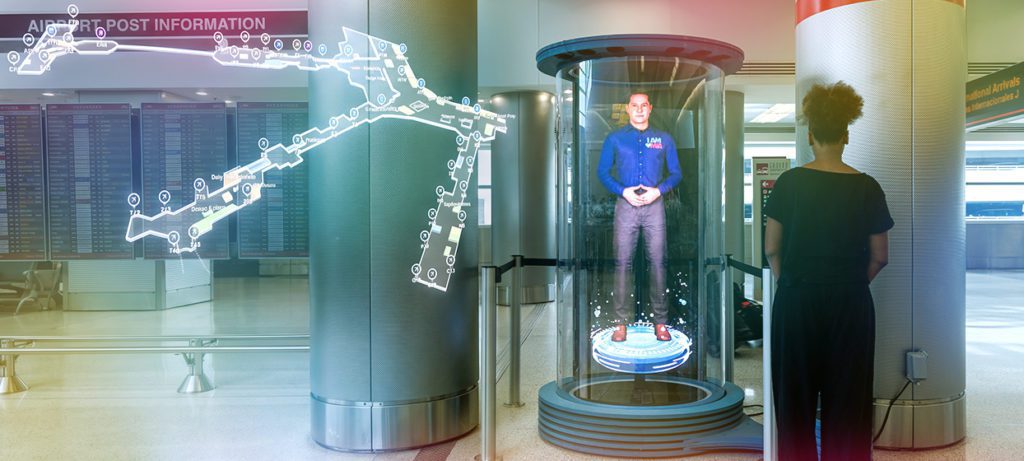
Enter, MIA Virtual Assistant – the first-ever large-scale, geo-aware agentic AI with web, mobile, kiosk and holographic digital avatar touchpoints rolled out across an airport. Unveiled at eMerge Americas 2026, this permanent passenger support service is setting a new standard for global travel operations and transforming MIA into a next-generation airport.
A New Vision for the Modern Airport
“An airport is an experience. It’s not just you going from one destination to the other.”
– Maurice Jenkins, Chief Innovation and Digital Strategy Officer, MIA
Calm, happy passengers are good for business. A study from JD Power found that passengers who rate their airport experience as ‘perfect’ spend an average of $42.39 in the terminal – $16.54 more than passengers who rate their airport experience as ‘just okay’. As airports evolve from transit points into experience centres, passengers want more than efficiency – they want to feel informed, entertained and in control of their journey.
MIA manages 60% of Florida’s international visitors and offers more flights to Latin America and the Caribbean than any other U.S. airport. Its terminal spans 10 million square feet. At that scale, with that diversity of travellers, the traditional model only goes so far. The airport already has static signage, a mobile app, and information desks staffed by volunteers to address customer needs. But customer service teams spend a significant portion of their time answering the same routine questions: where’s my gate, how do I get to the rental car centre, where can I eat.
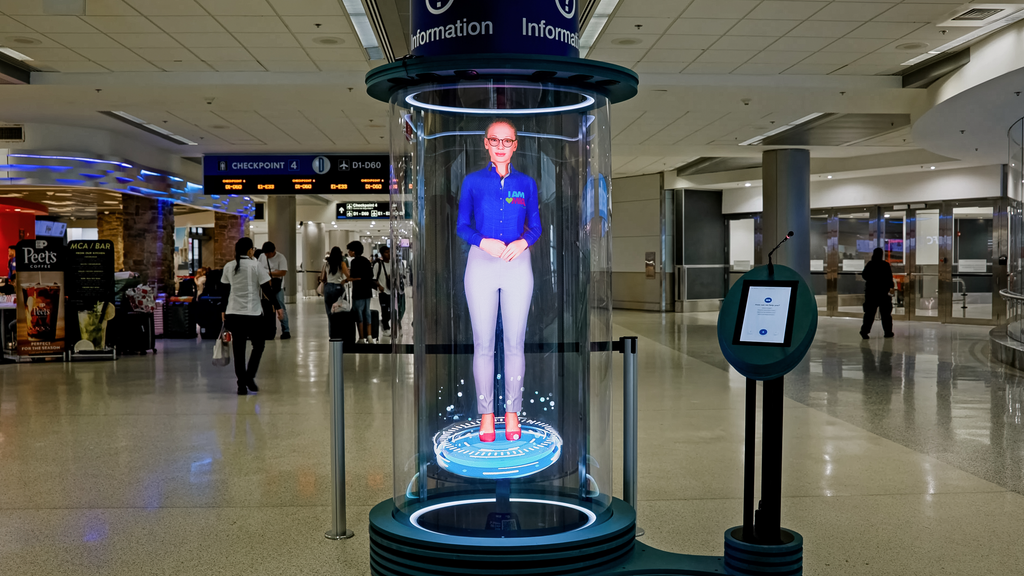
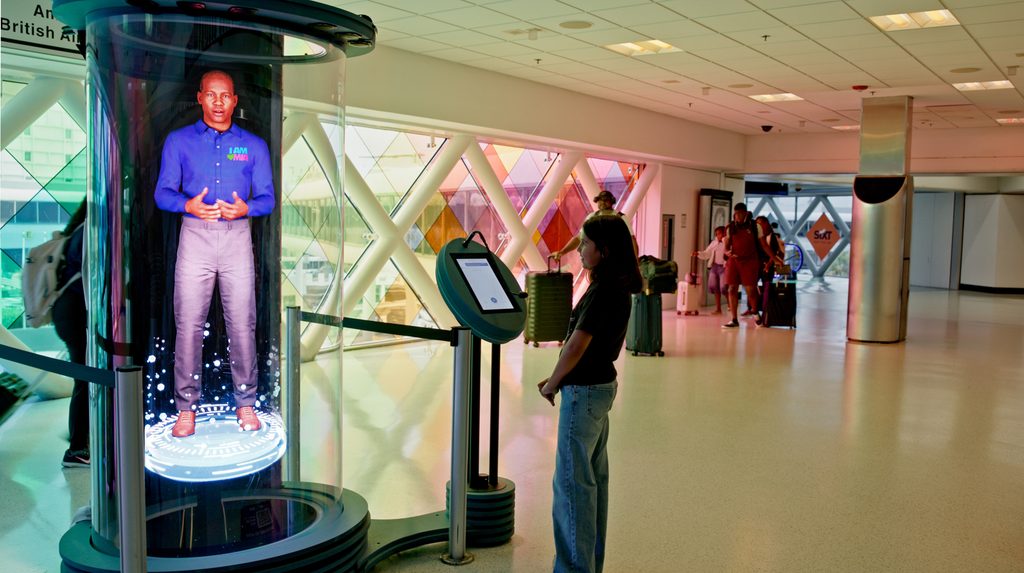
One of the four Virtual Assistant units at TSA Checkpoint 4 in the North Terminal.
MIA needed a technology that gives customers an alternative medium for those repetitive enquiries – and gives human staff the bandwidth to focus on the complex, high-touch tasks that actually need a person. With ambitions of creating what it calls Airport 2.0, MIA is rethinking the entire passenger experience from the ground up. “We’re leveraging innovation and tech to create a new, higher-end value-added experience across the airport ecosystem,” says Maurice.
The MIA Virtual Assistant: Built on Geo-Aware Agentic AI
“We’re very proud that we’re the first airport in the world to deploy that kind of integrated omni-channel chatbot technology in a hologram form.”
– Ralph Cutié, Director and CEO, MIA
Airports are some of the most difficult public spaces to navigate, and the stakes are high: missed flights, hours lost and immense stress in an already unfamiliar environment. The industry is rapidly implementing new technologies but many of them fall short. AI chatbots provide fast, accurate responses but they often feel like nothing more than a glorified search engine, particularly for the third of passengers who want to see signage that automatically translates into their language.
The MIA Virtual Assistant transforms information into practical, personalised support across platforms, with HYPERVSN’s interactive avatars forming the experiential touchpoint of this service. This breakthrough in CX for travel hubs was made possible through the collaboration of five partners.
Campaign 3D: Experiential integration and strategic partnership management
HYPERVSN: Holographic digital avatars
Mappedin: Indoor mapping and spatial intelligence
Radiant Technology: Real-time operational data translation
Satisfi Labs: Conversational AI abilities
“Typically, our passengers depend on signage. They depend on contacting our volunteers or our operations staff that are in the terminal to find their way around,” says Ralph. The MIA Virtual Assistant presents another option – one that’s available 24/7 and handles multilingual interactions during peak hours with ease. The digital concierge draws on live, contextual data and AI capabilities to deliver a more hands-on approach with real-time awareness of passenger location and nearby facilities.
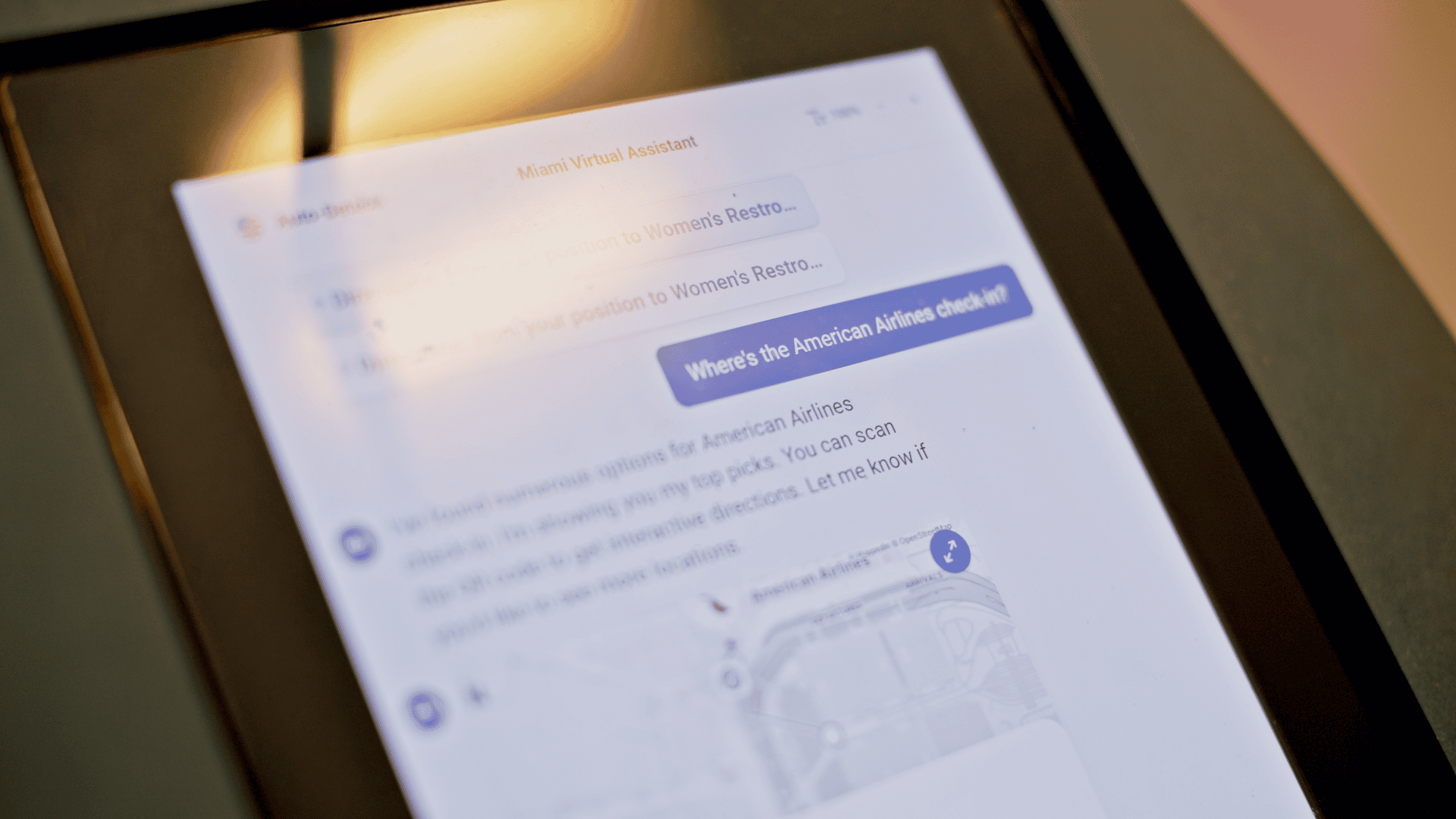
A conversation between a passenger and the Virtual Assistant displayed on a touchscreen.
Beyond automated responses and traditional web-and-app services and information resources, spatial intelligence is a key part of what makes the service different. Take a passenger looking for Gate B12. Rather than simply returning the gate number, the MIA Virtual Assistant uses the passenger’s location and the airport map to generate a route and guide them step by step from where they are.
The experience is made seamless with agentic AI at its heart, enabling multi-step actions – identifying language, pinpointing exact location, pulling live flight data and searching for nearby amenities – to happen within a single interaction and deliver a tailored response. Ralph puts it simply: “it’s like one little condensed sensor,” highlighting how these capabilities work together in a single exchange.
In the first month of use, the MIA Virtual Assistants completed over 20,000 interactions, generating notable interest from passengers.
Giving MIA’s AI Service a Holographic Human Face
“The goal and intent of the holograms, is to enhance the customer experience and provide additional value.”
– Maurice Jenkins, Chief Innovation and Digital Strategy Officer, MIA
Today’s travellers expect more from airports, and they’re increasingly comfortable with the use of technology to give them the best possible service. However, empathy, care and connection remain critical in providing this experience. ACI World’s 2026 GlobalTraveller Survey found that, beyond just wanting faster support, passengers value experiential interactions. They want technology-enabled offerings to remove friction in their journey without completely losing the human element.
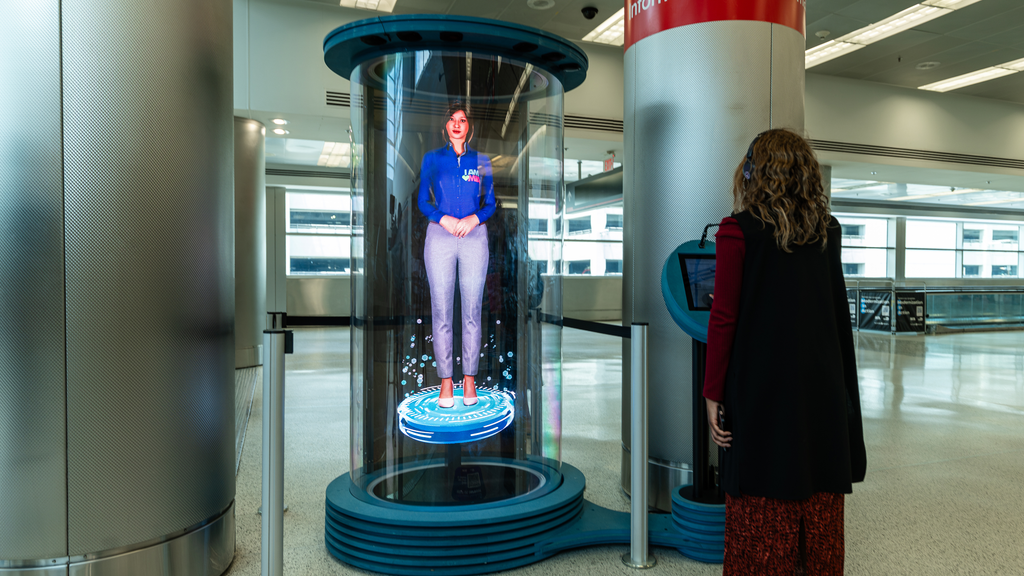
The holographic setup in Concourse J, South Terminal.
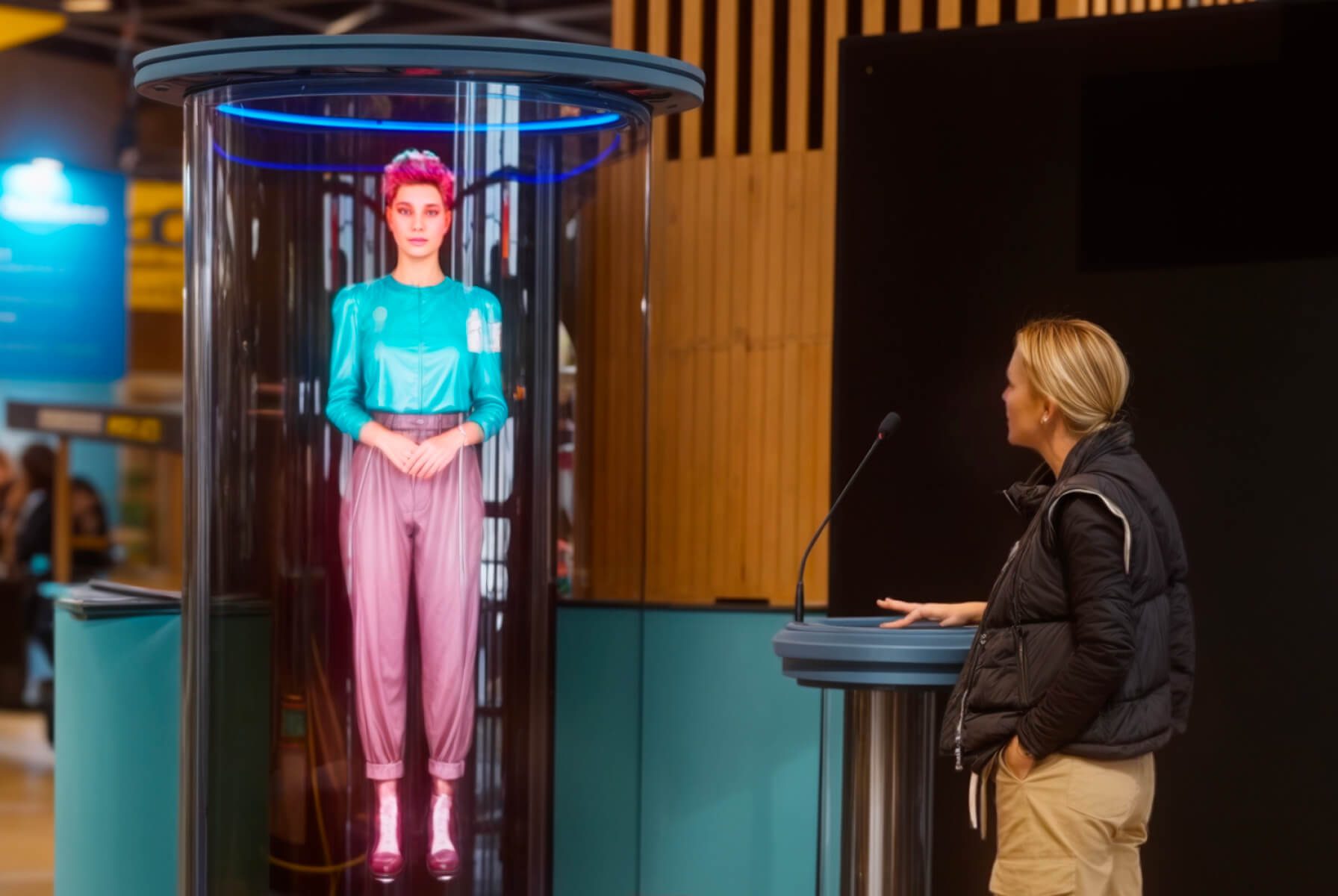
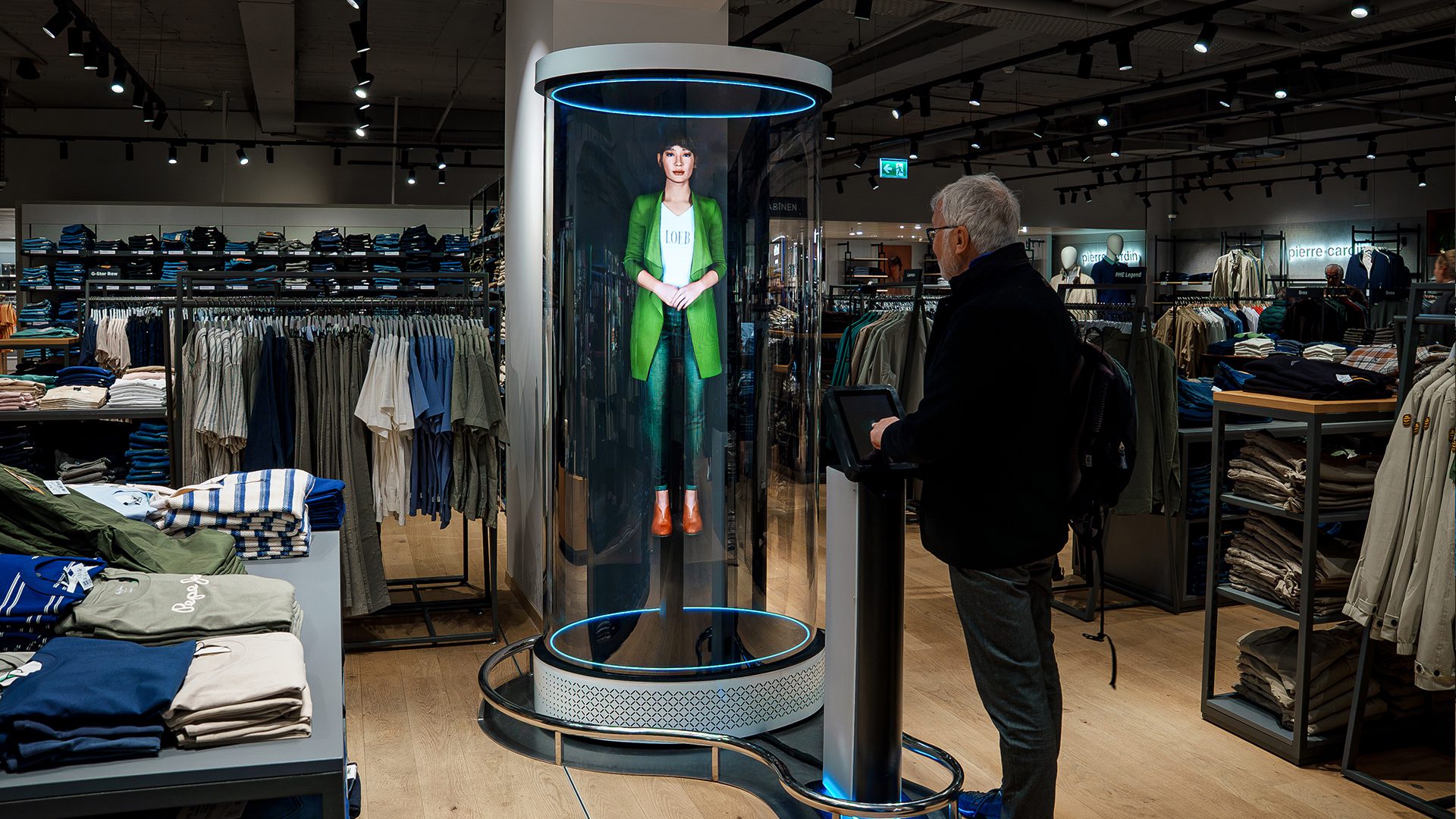
HYPERVSN’s digital human technology provides an essential layer of MIA’s AI-driven experience. It transforms this complex, connected passenger support service into an engaging, natural interaction. Built using the CTRL Human Platform, the interactive avatars create a more comfortable and approachable way for travellers to engage with the solution.
Human-Like Presence: Each AI hologram has a different appearance, reflecting the diversity of MIA’s global passengers. The hyper-realistic digital humans are dressed in matching MIA uniforms, signalling their role as brand representatives.
Multilingualism: MIA’s AI holograms speak 40 languages fluently and can communicate in over 100 languages through text on the touchscreen interface.
Accessibility: Passengers communicate as they would with a person – by speaking naturally. They receive responses through voice as well as text on screen, with further instructions sent to their mobile device if needed.
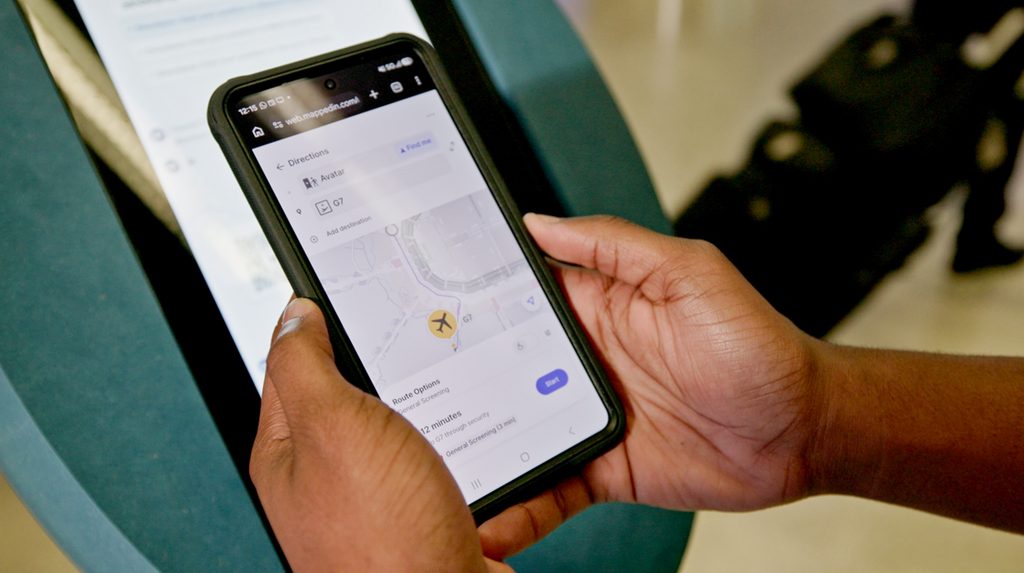
Sofia is rushing to catch a connecting flight when she spots one of the holographic avatars at an information point near Concourse J. She walks up to the hologram and asks for directions to her gate in Spanish. Within seconds, the AI assistant responds – also in Spanish – with her flight status, step-by-step directions to the correct concourse and the route on the touchscreen map, generating a QR code so she can follow along on her phone as she walks.
For directional enquiries, MIA passengers can access map-based routes via a QR code.
The MIA Virtual Assistant addresses passengers’ most common enquiries: flight and gate information, terminal navigation, retail and restaurant discovery, accessibility support, tourism information and real-time service updates. It provides what Ralph describes as “a tremendous customer enhancement,” helping the airport handle increasing passenger volumes while freeing up staff. For passengers, this means less reliance on static signage, which can be harder to find or navigate, and a smarter option when in-person assistance isn’t available or isn’t needed.
Speaking to CBS19, one passenger reflected on this new kind of interaction: “Time’s changing. You’ve got to change with it.” “There are several generations of individuals that you’re dealing with when you’re coming through an airport,” Maurice explains. “Some want to talk to human beings, some would like to leverage this concept and technology.” Travellers still have different preferences. MIA’s AI-powered service adds another way to get help while keeping a sense of human connection throughout the journey.
The FIFA World Cup Stamp of Approval
“The [FIFA] World Cup was a good key performance indicator for us. It gave us an opportunity to ingest this new technology into an airport ecosystem to see how well it can hold up.”
– Maurice Jenkins, Chief Innovation and Digital Strategy Officer, MIA
In the early stages of the MIA Virtual Assistant rollout, the four HYPERVSN AI Human units saw steady adoption, but the real test came in June, when Miami hosted the FIFA World Cup 2026. Airport capacity surged as millions of visitors arrived from around the world, and the virtual assistants’ knowledge bases were upgraded with the resources needed to inform, guide and entertain them at every step.
“Miami’s World Cup experience began at its gateway,” recalls Ralph, highlighting the airport’s role in shaping visitors’ first impressions of the city’s hospitality. During the tournament, visitors to the airport could use the MIA Virtual Assistants to access everything from directions to the stadium to information on fan activations popping up around the city. The Virtual Assistants were there to kick off their whole Miami adventure with interactive, personalised assistance – just like a friendly local. Maurice shares: “The kids were enjoying it, being able to take pictures and understanding the technology. It was a good framework for creating an experience.”
Young traveller exploring the Virtual Assistant at the MIA Mover during the FIFA World Cup 2026.
Utilisation of MIA’s passenger support service grew from 7% to 10% over the course of the World Cup. The MIA team expects this growth to continue.
What’s Next for the Airport of the Future
“The MIA Virtual Assistant represents exactly what we built HYPERVSN’s digital human technology to do – take powerful AI and make it feel human, accessible and real.”
– Kiryl Chykeyuk, Co-Founder and CEO, HYPERVSN
HYPERVSN’s AI Human platform gave MIA’s multi-channel agentic service an interactive way to communicate with passengers. Maurice also sees the technology extending into new territory. “We’re looking to take it beyond just a customer experience, but also…for the employees to be able to use and actually take one tool and create a more of an enhanced value-added resource.”
Following the rollout of the first group of virtual assistants, MIA has announced plans to expand with additional holographic setups across the airport. For HYPERVSN, this pioneering project is a blueprint for how AI humans can transform interactions – providing multilingual, always-on support that can adapt to different needs and touchpoints across the passenger journey.


































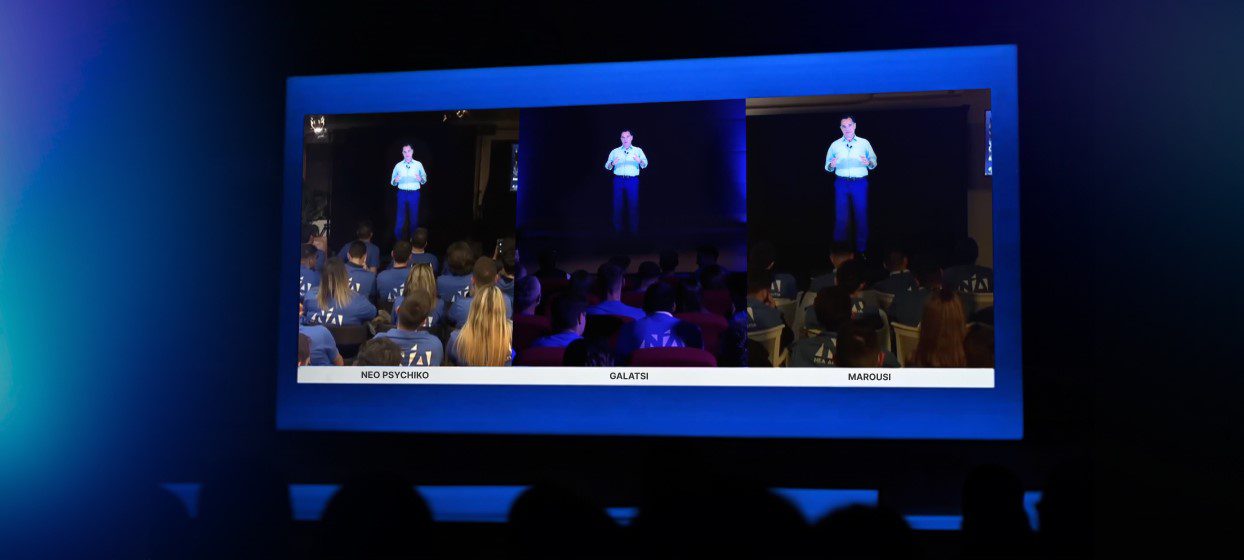





“We’re not just keeping pace with innovation. We’re leading it, harnessing artificial intelligence to transform how we serve our visitors and our community every day. At Miami International Airport, we are creating a smarter, more connected, and truly future-ready Miami-Dade County.”
– Daniella Levine Cava, Mayor of Miami-Dade County